
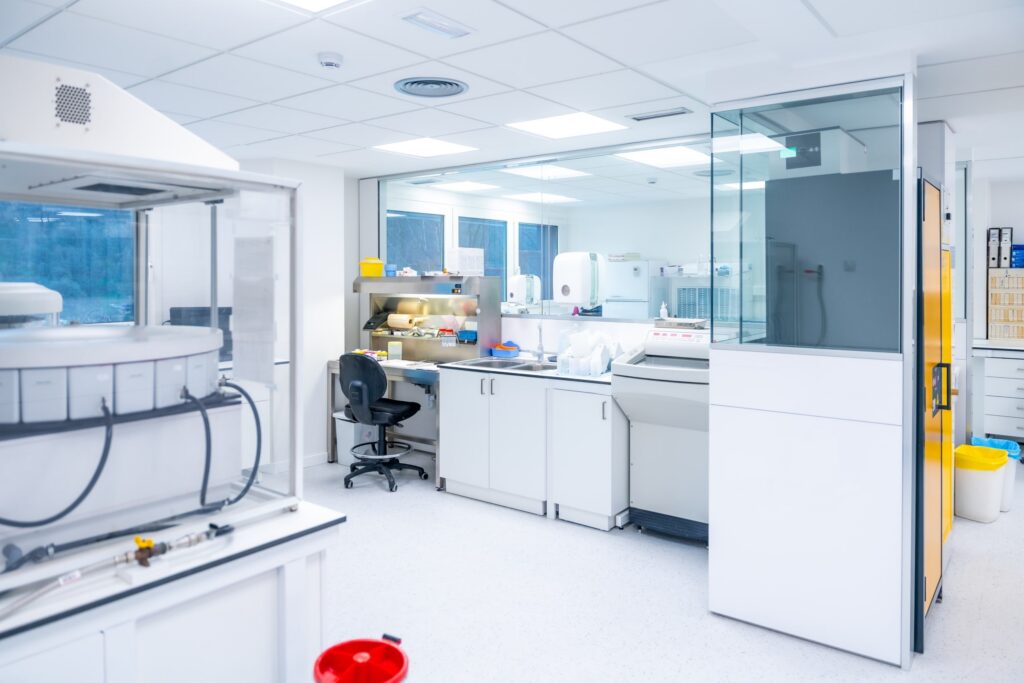
Moving is stressful and disruptive, even under the best circumstances. When the move involves a laboratory, the complexity increases, and the stakes rise. A laboratory is a finely tuned engine of innovation where multi-million-dollar assets and years of data intersect, and securing an experienced lab relocation partner is mission-critical during this transition. Relocating to a new facility is a crucial moment that can catalyze a new era of breakthrough research or stall progress through unmitigated risk.
Many organizations approach the physical transition with a reliance on common-sense assumptions, but treating highly sensitive scientific instruments like standard office furniture is a common pitfall.
A modest investment in an experienced lab relocation partner pales when compared to the replacement cost of a damaged mass spectrometer or the irreparable loss of five years of research samples. Engaging relocation services from an experienced lab relocation partner shifts the focus toward science-first advocacy and helps protect your research from relocation catastrophe.
1) Orchestrating the Technical Proxy
One of the greatest hidden drains on internal resources is the coordination of various manufacturers. A standard lab may house equipment from 20 or more different Original Equipment Manufacturers (OEMs). Each requires specific decommissioning and recommissioning protocols to maintain warranty validity.
Without lab relocation assistance, a Lab Manager is forced to act as a dispatcher, coordinating dozens of service engineers and verifying credentials. An experienced partner serves as the single point of contact, acting as the technical liaison, absorbing the administrative burden, and allowing the scientific team to remain focused on core research.
2) Protecting Digital Continuity and Software Integrity
The physical safety of an instrument is only half of the equation. A significant gap in traditional relocation planning is the neglect of the digital layer. Organizations often treat specialized workstations as standard IT equipment, which leads to the nightmare of orphaned data.
If a specialized PC is separated from its instrument without a pre-move digital audit, the software-hardware handshake may be lost upon reinstallation. We conduct comprehensive software versioning checks and data backups prior to physical disconnection. The goal is to ensure the software environment remains intact, preventing the loss of local databases that are often not captured by enterprise-wide cloud backups.
3) Upholding Technical Compliance and Documentation
Healthcare research is governed by strict regulatory standards known as GxP (Good Practice), which include guidelines for laboratory, clinical, and manufacturing environments. Standard movers lack the technical literacy to handle the specialized Installation (IQ), Operational (OQ), and Performance Qualifications (PQ) required to maintain these standards. Failure to properly document these steps can result in a total loss of GxP compliance.
An experienced partner coordinates directly with OEMs to ensure every protocol is followed exactly. This precision preserves high-value service contracts and prevents the voiding of warranties. The move is treated as a technical engineering project rather than a manual labor task to protect the delicate internal components of high-performance liquid chromatography systems or the alignment of a mass spectrometer.
4) Securing Assets via Advanced Chain of Custody
In the realm of life sciences, the samples are often more valuable than the hardware. A freezer failure during transit can result in the loss of irreplaceable biological assets, effectively resetting years of research. Protecting these assets requires more than a refrigerated truck.
- Redundant Power Infrastructure: Utilizing active monitoring and backup power for freezers and incubators throughout the transit window.
- Climate-Controlled Logistics: Managing transport requirements ranging from ambient temperatures to cryogenic levels (180°C).
- RFID Asset Tracking: Providing real-time visibility into the exact location and environmental status of every critical research material.
5) Implementing a Phased Continuity Framework
Success in complex projects requires establishing a 6-to-12-month planning horizon. Waiting until the final weeks to secure specialized transport often leads to complications.
We utilize a block move strategy to protect scientific progress. By executing the relocation in calculated phases, we maintain partial lab capacity. This ensures that while one wing is being validated in the new facility, critical research continues in the old one. We also establish mandatory contingency protocols to account for power failures or logistics delays, ensuring your timeline remains secure.
Quantifying Strategic Risk Management
Business leaders know that relying on generalist providers for specialized technical transitions is a recipe for disaster. While a standard mover excels at volume, they lack the specialized protocols required to mitigate the severe financial and operational impacts of a failed lab move. Transitioning a laboratory requires an advisory partner who understands the gravity of your intellectual property and the nuances of scientific infrastructure. The following table highlights the differences in approach between generalist movers and partners with deep lab expertise.
| Risk Factor | General Office Mover | Experienced Lab Partner |
|---|---|---|
| Administrative Drain | Client must manage several OEM vendors | Single point of contact for all manufacturers |
| Orphaned Data | Treats PCs as standard hardware | Pre-move digital audits and software validation |
| Regulatory Failure | No IQ/OQ/PQ literacy; potential for voided warranties | Full GxP compliance and documentation |
| Asset Loss | Standard freight with high failure risk | Active monitoring and redundant power for assets |
| Operational Stagnation | All-or-nothing move; high downtime | Phased block-move strategy for constant uptime |
Secure the Future of Scientific Success with Lab Relocation Assistance
A laboratory relocation is a high-stakes pivot point, and treating this transition as a simple logistical exercise introduces unnecessary risk. The 99:1 dilemma suggests that while 99% of a move may go well, the 1% that fails, such as a dropped instrument or a lost database, can represent 100% of the project’s value.
The value of an experienced lab relocation partner is found in the restoration of price stability and the protection of intellectual property. Pivotal Project Management has extensive lab relocation experience and can help protect the future of your research. We act as your advocate, providing clarity throughout the relocation process to ensure your new facility is operational from Day 1.